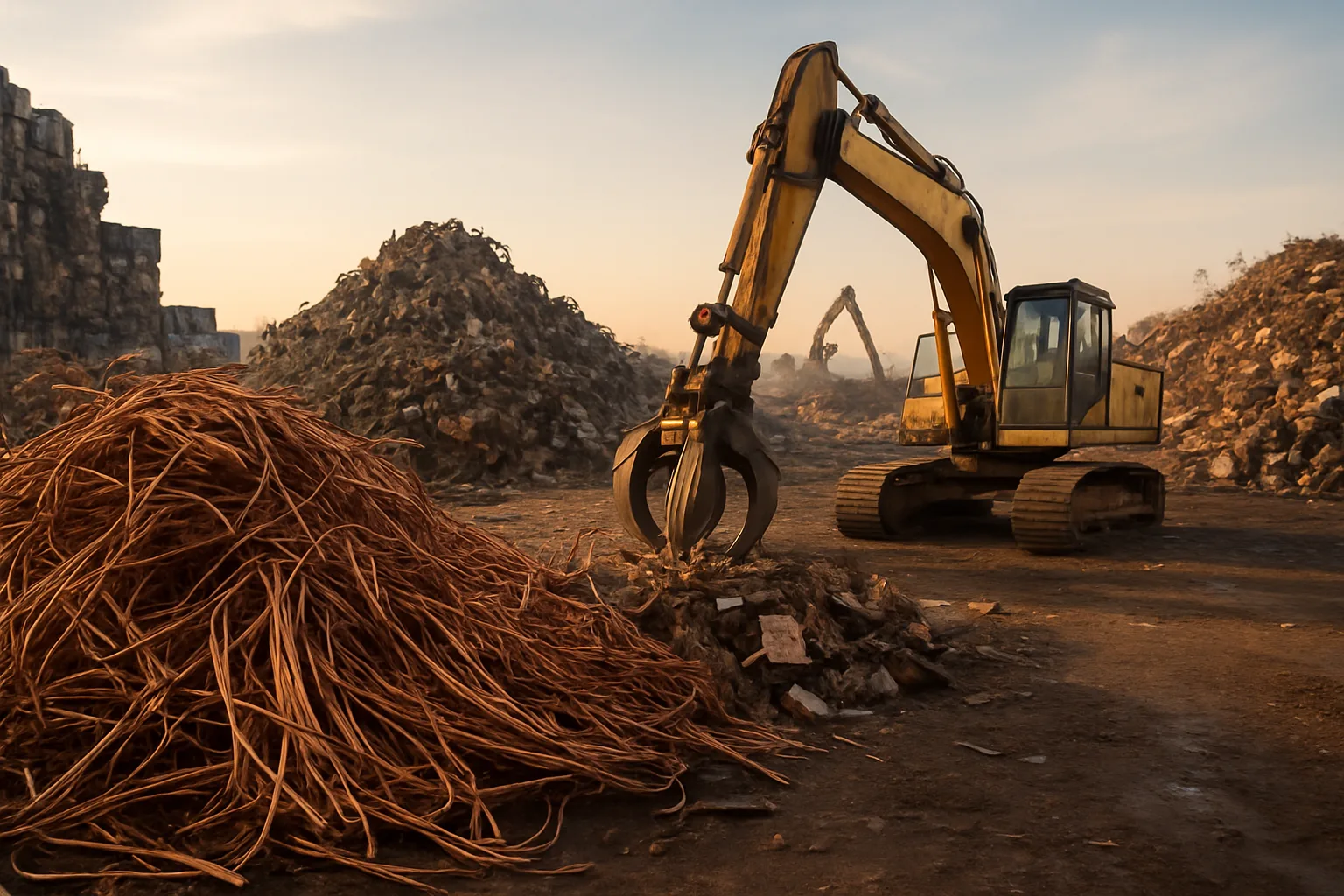
Why the Price of Copper in Shanghai Affects What You Get Paid in Montreal
If you checked the copper scrap price today and it looks different from last week, you're not imagining it. Scrap metal prices don't move in isolation. They're tied to global commodity markets, currency exchange rates, manufacturing demand, and trade policy — and all of that shifts constantly. Understanding why helps you sell smarter, not just sooner.
This week's market recap breaks down what's driving scrap prices across Canada right now, what it means for sellers in Montreal and across Quebec, and how to position yourself to get the best return on your material.
How Global Markets Set the Floor for Canadian Scrap Prices
Scrap metal is a global commodity. Whether you're hauling copper wire, aluminum extrusions, or a load of mixed non-ferrous, the price you're quoted at the yard is downstream of decisions made in London, Shanghai, and Chicago. The London Metal Exchange (LME) sets benchmark prices for copper, aluminum, zinc, and lead. Those benchmarks ripple outward to every recycling yard in North America within hours.
When Chinese manufacturing demand rises, copper gets consumed faster. Tighter supply pushes LME copper higher. That increase eventually shows up in what a Montreal yard is willing to pay for your clean bare bright or your #1 copper. The reverse is also true — a slowdown in Asian manufacturing can pull prices down fast, sometimes within the same week.
Here's what's been moving the needle in mid-2026:
- USD/CAD exchange rate: Most metals are priced in USD globally. When the Canadian dollar weakens against the U.S. dollar, Canadian sellers can sometimes see a modest buffer — yards buying in CAD but selling into USD-denominated markets may adjust their buy prices slightly upward. Don't count on it, but it's a real factor.
- Global copper demand: Electrification continues to drive copper consumption hard. EV production, grid infrastructure, and battery storage projects are all copper-intensive. That structural demand has kept copper prices from falling off a cliff even when broader economic signals soften.
- Aluminum pressure from tariffs: Trade policy between the U.S. and key aluminum-producing nations continues to create price volatility. Yards across Canada are watching cross-border flow carefully.
- Steel and ferrous softness: Construction slowdowns in several major markets have kept ferrous prices under pressure. If you're moving HMS or shredded steel, don't expect a windfall right now.
None of this means you're powerless. It means timing your sale and knowing your material matters more than ever. To check today's Canadian scrap metal prices, use current market tools rather than guessing based on what you got paid three months ago.
What the Copper Scrap Price Today Means for Montreal Sellers
Copper is the bellwether metal. When people in the scrap industry want to know how the market is feeling, they look at copper first. The copper scrap price today reflects global supply and demand compressed into a single number — and right now, that number is being pushed and pulled by competing forces.
On the demand side, electrification infrastructure spending across North America remains strong. Federal and provincial investments in grid upgrades, EV charging networks, and renewable energy installations all feed copper consumption. That's a tailwind for prices.
On the supply side, new mining production coming online in South America is adding to refined copper availability. More supply without proportionally more demand typically softens prices at the margin. The net result? Copper prices are holding in a range, but they're not running away to the upside either.
For sellers in Montreal scrap metal services, this environment rewards preparation. Clean, well-sorted copper commands a premium over mixed loads or insulated wire every single time. A yard paying spot minus a processing spread on clean bare bright will discount heavily on anything that needs sorting. Do the work before you show up, and the price difference goes in your pocket.
Grades matter in this market more than ever:
- Bare bright copper: Top of the scale. Clean, uncoated, unalloyed wire. Highest price per pound.
- #1 copper: Clean copper pipe and wire, no fittings, no paint. Strong pricing, widely accepted.
- #2 copper: Includes painted, coated, or slightly corroded copper. Discounted from #1.
- Insulated copper wire (ICW): Priced on estimated copper recovery. Recovery percentage matters enormously.
- Copper breakage / mixed copper: Lowest tier. Expect a significant discount.
Knowing where your material sits on that ladder — before you walk in — is the difference between getting paid fairly and leaving money behind.
The Week in Scrap: What's Moving and What's Sitting in Canada
This week across scrap metal recycling Canada markets, here's the general picture based on conditions heading into July 2026:
Non-ferrous metals remain the strongest performers. Copper and aluminum are holding relatively firm. Aluminum — particularly clean extrusions, sheet, and cast — continues to benefit from steady automotive and packaging demand. If you're holding aluminum, this isn't a bad time to move it.
Stainless steel markets are mixed. Nickel prices, which heavily influence stainless grades, have been choppy. 304 stainless is still a solid earner compared to ferrous, but the premium over carbon steel has tightened versus earlier in the year.
Catalytic converters (cats) remain one of the most watched items on any lot. PGM (platinum group metal) prices drive cat values, and those markets are volatile. If you're sitting on a pile of cores, get them evaluated regularly — holding too long in a declining PGM market costs real money.
Ferrous — HMS, shredded, plate and structural: Demand is soft. If you have flexibility, this is a category where waiting for a better signal makes sense. If you need to move it, move it — but don't expect a surprise on the upside this week.
For sellers in Montreal and across Quebec, local yard conditions can vary from the national average. Regional demand, trucking costs, and local buyer competition all affect what you're actually offered. Find current Canadian scrap metal prices and compare before you commit to a single buyer.
Why Selling to One Buyer in a Volatile Market Is a Losing Strategy
When prices are moving — up or down — relying on a single buyer is where sellers lose the most money. One phone call to one yard, one quote, one decision. That's not price discovery. That's just accepting whatever number you're given.
The old way of selling scrap was built around relationships and convenience. You called your guy, he made an offer, you took it or left it. The problem is that in a volatile global market, your guy's offer reflects his margin requirements, his current inventory position, and his competition — not necessarily what your material is actually worth on the open market.
More buyers bidding on your material means better price discovery. Full stop. That's not a theory — it's how every other commodity market in the world works. Auctions and competitive bidding exist because they reveal real market prices, not just the first number someone is willing to offer.
This is exactly where SMASH changes the equation for Canadian sellers. Instead of one call to one buyer, your load goes in front of vetted buyers across North America. Real competition. Documented material with photos, weights, and proper descriptions. Auto-invoicing. No subscription fees — SMASH only wins when you do.
Platforms like SMASH help you find the best price for your scrap in Canada by replacing guesswork with competition. In a market this volatile, that difference is measurable.
How to Protect Your Returns When Prices Are Unpredictable
You can't control the LME. You can't control trade policy or what happens to demand in China. But you can control how prepared your material is, how well you document it, and how many buyers see it. Those are the levers you actually have.
Practical steps for sellers navigating a volatile market in 2026:
- Sort before you sell. Mixed loads get mixed (low) prices. Separating copper grades, aluminum alloys, and ferrous from non-ferrous takes time, but pays back in price per pound.
- Document everything. Photos, weights, descriptions. Buyers bid higher on material they can see and verify. Vague listings generate low bids or no bids.
- Watch the weekly price trend, not just today's number. A rising market rewards holding a few days. A falling market rewards moving fast. Read the latest Canadian scrap metal market updates to stay ahead of the curve.
- Get multiple offers. Never accept the first number without checking it against the market. Competition is your friend.
- Know your grades. Walking into a yard and calling everything "copper" or "aluminum" costs you money. Learn the grades your material falls into before you quote or accept a quote.
For anyone doing regular volume — whether you're a yard operator, a demolition contractor, or an independent collector in the Montreal area — building a process around these steps turns market volatility from a threat into an opportunity.
Global markets will keep moving. That's not changing. What changes is whether you're positioned to respond to those moves intelligently or just hope for the best every time a load is ready to go.
Stay current. SMASH and scrap-metal-prices.ca exist to give you the data and the platform to do exactly that. The copper scrap price today is just one data point — make sure you're looking at all of them before you sell.
Frequently Asked Questions
Q: What is the copper scrap price today in Montreal?
Copper scrap prices fluctuate daily based on LME benchmark rates, local yard conditions, and the USD/CAD exchange rate. Bare bright copper consistently commands the highest price, followed by #1 copper, #2 copper, and insulated wire. For the most current rates, check today's Canadian scrap metal prices directly — don't rely on prices from last week.
Q: Why do copper scrap prices change so frequently?
Copper is traded as a global commodity on exchanges like the London Metal Exchange (LME). Prices shift based on manufacturing demand (particularly from China and the EV sector), mining supply, currency movements, and trade policy. Those global changes filter down to your local yard's buy price, sometimes within hours of a major market move.
Q: How do I get the best copper scrap price in Montreal?
Sort your copper by grade before you sell — bare bright, #1, and #2 command very different prices. Document your material with photos and accurate weights. Most importantly, don't sell to just one buyer. Getting competitive offers from multiple vetted buyers through a platform like SMASH is the most reliable way to ensure your material sells at fair market value rather than one yard's preferred margin.
Q: Does the exchange rate between USD and CAD affect scrap metal prices in Canada?
Yes. Most metals are globally priced in USD. When the Canadian dollar weakens against the U.S. dollar, the effective price Canadian sellers receive can shift — yards buying in CAD and selling into USD markets factor this into their buy prices. It's one of several variables that makes monitoring current rates important for active sellers in Quebec and across Canada.
Q: Is scrap metal recycling in Montreal affected by global trade policy?
Absolutely. Tariffs, trade agreements, and import/export restrictions between major economies affect metal flows and pricing across North America. Aluminum in particular has been sensitive to trade policy shifts in 2026. Sellers in Montreal and across Quebec aren't insulated from these pressures — which is exactly why understanding the global context behind your local scrap price matters.
Markets move fast. The best thing you can do is stay informed and sell smart. Check today's Canadian scrap metal prices — get current rates at scrap-metal-prices.ca before your next load goes out the door.
Follow SMASH on LinkedIn for weekly scrap metal market insights, pricing trends, and industry updates across Canada.
Disclaimer: Scrap metal prices fluctuate based on global market conditions, local demand, material grade, and other factors. Prices referenced in this article are general market context only. Always verify current rates with your local yard or through a live pricing source before selling.