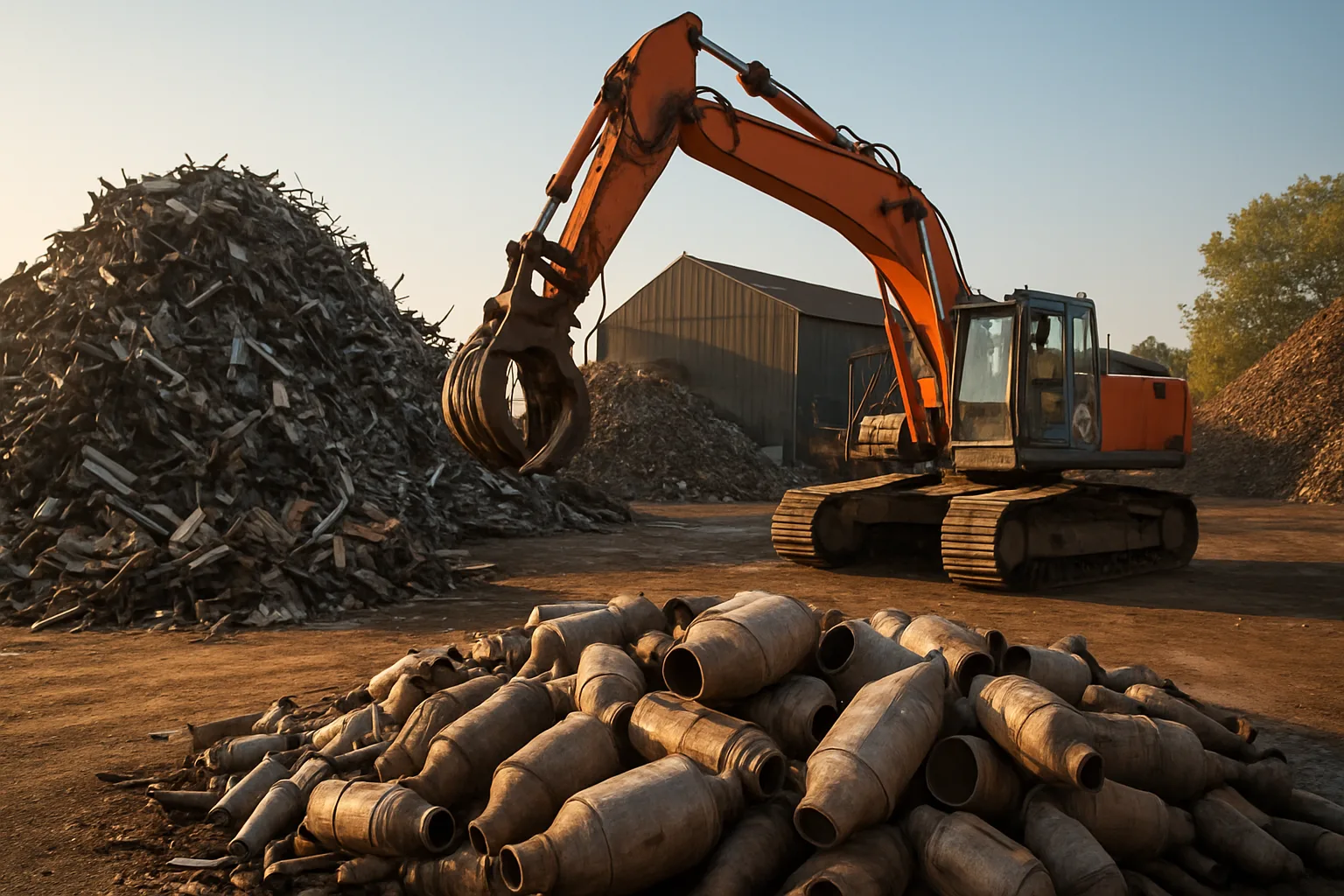
Catalytic Converter Recycling in Canada: How It Works and Why the Price You Get Can Vary Wildly
You pulled a catalytic converter off a vehicle and someone offered you $40. Your neighbour sold an identical-looking unit last month for $180. Same part, same yard, totally different outcome. That gap isn't random — and understanding why it exists is the difference between leaving money on the table and getting what your material is actually worth.
Catalytic converter recycling is one of the most misunderstood corners of the scrap market. Prices shift week to week. The steel scrap price today matters, but with cats, the platinum group metals (PGMs) inside — platinum, palladium, and rhodium — drive most of the value. This week's market recap breaks down how the recycling process actually works, what moves the price, and how sellers across Ontario can stop guessing and start getting paid fairly.
Before we get into the mechanics, check today's Canadian scrap metal prices — rates move fast, and knowing where the market sits right now gives you a baseline before you negotiate anything.
What Actually Happens When a Catalytic Converter Gets Recycled
Most sellers treat cats like any other chunk of scrap — weigh it, take a price, move on. That's the wrong framework entirely. The steel shell of a converter has scrap value, sure. But the real money is in the ceramic or metallic substrate inside, which is coated with PGMs during manufacturing to filter exhaust gases.
Here's the recycling chain in plain terms:
- Collection: Converters are pulled from end-of-life vehicles at salvage yards, auto recyclers, and garages. They get sorted roughly by vehicle type and origin.
- Decanning: The steel outer shell is removed, exposing the substrate inside. This is often done at a processor level, not at your local yard.
- Sampling and assay: The substrate is crushed, sampled, and sent for chemical analysis (assay) to determine the exact PGM concentration. This is where real value is established — not at the scale.
- Smelting and refining: The crushed substrate goes through a smelter to extract the PGMs. The recovered metals then go into industrial and manufacturing supply chains.
- Settlement: The refiner pays based on actual PGM recovery. That value works its way back down the chain — ideally to you.
The problem? Most individual sellers never see that assay data. You're selling based on someone else's estimate of what's inside. That information gap is exactly where margin gets captured by middlemen instead of you.
Why the Steel Scrap Price Today Doesn't Tell the Full Story for Cats
If you're tracking the scrap metal prices today to value your catalytic converters, you're only reading half the market. The steel shell — the outer casing — does carry ferrous scrap value, and yes, the steel scrap price today in Ontario factors into that component. But that's a fraction of what a converter is worth.
PGM prices are quoted in troy ounces on global commodity exchanges. As of mid-2026, the PGM market has seen continued volatility driven by several overlapping forces:
- EV transition pace: Slower-than-projected EV adoption has kept demand for catalytic converters in new ICE vehicles higher than analysts expected. That supports palladium demand.
- South African supply constraints: South Africa produces a dominant share of the world's PGMs. Any disruption to mining output — power, labour, logistics — ripples directly into prices.
- Industrial demand: Beyond automotive, platinum is used in hydrogen fuel cell technology. Growing interest in hydrogen infrastructure has kept a floor under platinum prices.
- Recycled supply volumes: As more vehicles reach end-of-life, secondary PGM supply from recycling is increasing, which puts some downward pressure on pricing over time.
The bottom line: a cat's value is a moving target tied to global commodity markets, not just what's posted on a local yard's price board. Sellers in Guelph who treat every converter the same are consistently underselling their material.
Why Prices Vary So Much — and What You Can Do About It
Walk three converters into three different buyers and you may get three completely different quotes. That's not fraud — it's information asymmetry at work. Each buyer has a different processing relationship, a different cost structure, and a different idea of what that unit will yield at the refinery.
Here's what actually drives the price spread you see on cats:
- Unit identification: Buyers use serial numbers, OEM part numbers, and vehicle application databases to estimate PGM content before they even open the unit. A properly identified converter commands a better price than an unidentified "mystery cat."
- Condition: Damaged, crushed, or water-contaminated substrates yield less. A converter that's been smashed with a hammer to remove it is worth less than one pulled cleanly.
- Volume: A yard selling 50 units at a time gets better pricing than someone walking in with two. That's just leverage.
- Buyer access: If you're selling to a single local buyer with one processing partner, you're at the mercy of that one relationship's margin structure. More buyers means better price discovery.
- Market timing: Selling when PGM prices are down versus selling into a spike can mean a 30-40% swing in returns on the same physical unit — no exaggeration.
This is exactly where platforms like Canada's B2B scrap recycling marketplace change the dynamic. When your converters go in front of multiple vetted buyers simultaneously, you stop relying on one buyer's estimate and start seeing where the actual market sits. That competition is how price discovery happens.
How to Document and Prepare Catalytic Converters for Better Returns
Documentation isn't just about compliance — it's about money. A well-documented lot of catalytic converters sells better because buyers have more confidence in what they're buying. Less uncertainty on their end means less discount built into the offer.
If you're selling cats in Ontario — whether you're a salvage yard in Guelph, an auto recycler in Hamilton, or a shop clearing out accumulated inventory — here's what makes your lot more competitive:
- Photo every unit. Clear photos of the inlet, outlet, and serial number plate. Platforms that require photo documentation weed out low-quality lots and attract serious buyers.
- Record serial and part numbers. Serial tracking isn't just for legal compliance — it tells the buyer exactly what PGM loading to expect.
- Note vehicle application where known. A converter from a 2019 pickup diesel is valued very differently from one off a subcompact hatchback.
- Disclose condition accurately. Cracked substrates, damaged flanges, cut pipes — note it upfront. Buyers who find surprises at inspection adjust their pricing downward hard.
- Group intelligently. Lots grouped by vehicle type or converter grade get cleaner bids than mixed mystery lots.
SMASH builds this documentation process into the listing workflow. Serial tracking, photo requirements, and inventory structuring are part of how lots get presented to buyers — which means sellers show up looking credible and buyers bid with confidence. That's the SMASH scrap metal auction model: structured, transparent, competitive.
Guelph and Ontario Sellers: What the Market Looks Like Right Now
For sellers in Guelph and across Ontario, the mid-2026 cat market reflects the broader PGM volatility playing out globally. Palladium has pulled back from its multi-year highs but remains elevated relative to historical norms. Platinum has shown more strength recently, supported by industrial demand. Rhodium — always the wildcard — continues to trade at significant premiums when supply tightens.
What this means practically: the spread between what a well-informed seller gets and what an uninformed seller gets is wide right now. That gap is an opportunity for yards and collectors in Ontario who do the work to identify, document, and competitively market their material. If you're selling to one buyer by phone, you're not seeing the market — you're seeing one buyer's interpretation of it.
To find current Canadian scrap metal prices and benchmark where cats and other non-ferrous material are trading today, check current rates before you lock in any deal. Knowing the baseline is non-negotiable.
Also worth noting: if you're accumulating converters in the Guelph area and want to understand your options for moving them as a lot, exploring Guelph scrap metal services gives you a local starting point for connecting with buyers and platforms that serve this market.
The Right Way to Sell Catalytic Converters: Stop Guessing, Start Competing
The old playbook — call your one buyer, take whatever they offer, move on — costs you money every time you use it. Cats are too volatile and too valuable for that approach. The PGM content in a single converter can be worth more than an entire load of prepared steel, and yet most sellers treat the pricing process with less rigour than they'd apply to a load of copper wire.
The right approach looks like this: identify your units, document them properly, know what the market is doing, and get them in front of multiple buyers. That's not complicated — it just requires access to the right infrastructure. SMASH is built for exactly this. No subscription fees. The platform earns when sellers earn. Vetted buyers, competitive auction format, and the documentation tools to make your lot look credible before it ever hits the market.
For the latest on where the cat market sits this week, read the latest Canadian scrap metal market updates — staying current on PGM trends is how you time your sales intelligently instead of just whenever it's convenient.
Prices are moving. The market isn't waiting. If you've got cats sitting in a bin waiting for a better day to sell, make sure that better day comes because you've got better buyers — not just because you got lucky on timing.
Check today's Canadian scrap metal prices and get current rates at scrap-metal-prices.ca — knowing where the market sits right now is the first step to getting paid what your material is actually worth.
Frequently Asked Questions
Q: Why does the steel scrap price today matter for catalytic converter recycling?
The steel shell of a catalytic converter does carry ferrous scrap value tied to the steel scrap price today, but it's a minor component of the total value. The real driver is the PGM content — platinum, palladium, and rhodium — inside the substrate. Tracking both steel and PGM prices gives you a complete picture of what your converter is worth.
Q: How do I find out what my catalytic converter is worth in Guelph?
Start by identifying the serial or part number on the unit — most buyers use databases to estimate PGM content based on the OEM application. Then get quotes from multiple buyers rather than accepting the first offer. Platforms like SMASH connect Ontario sellers with vetted buyers in a competitive auction format, which helps reveal where the real market sits rather than relying on a single buyer's quote.
Q: Why do catalytic converter prices vary so much between buyers?
Each buyer has a different processing relationship, cost structure, and estimate of what the converter will yield at the refinery. Without assay data, every buyer is making an educated estimate — and those estimates vary. The wider your buyer pool, the closer you get to actual market value. Selling to one buyer by phone guarantees you see only one version of the price.
Q: Are scrap metal prices today in Canada affected by global PGM markets?
Yes, directly. Catalytic converter prices in Canada follow global platinum, palladium, and rhodium spot prices, which trade in USD on international commodity exchanges. Currency fluctuations between CAD and USD also affect what Canadian sellers ultimately receive. Monitoring both local scrap metal prices today and global PGM trends is essential for timing your sales effectively.
Q: Is there a B2B scrap metal marketplace that handles catalytic converters in Ontario?
Yes. SMASH operates as a B2B scrap metal marketplace connecting Canadian yards and sellers with vetted buyers across North America, including for catalytic converter lots. The platform uses structured inventory tools, photo documentation, and a competitive auction format — no subscription fees, and it's built to serve professional sellers who want more than a single phone-call offer.
Follow SMASH on LinkedIn for weekly scrap metal market insights, PGM price updates, and industry news that keeps you ahead of the market.
Disclaimer: Scrap metal prices fluctuate daily based on global commodity markets, local demand, and material condition. All prices referenced are general indicators only. Always verify current rates directly with buyers or at scrap-metal-prices.ca before making selling decisions.