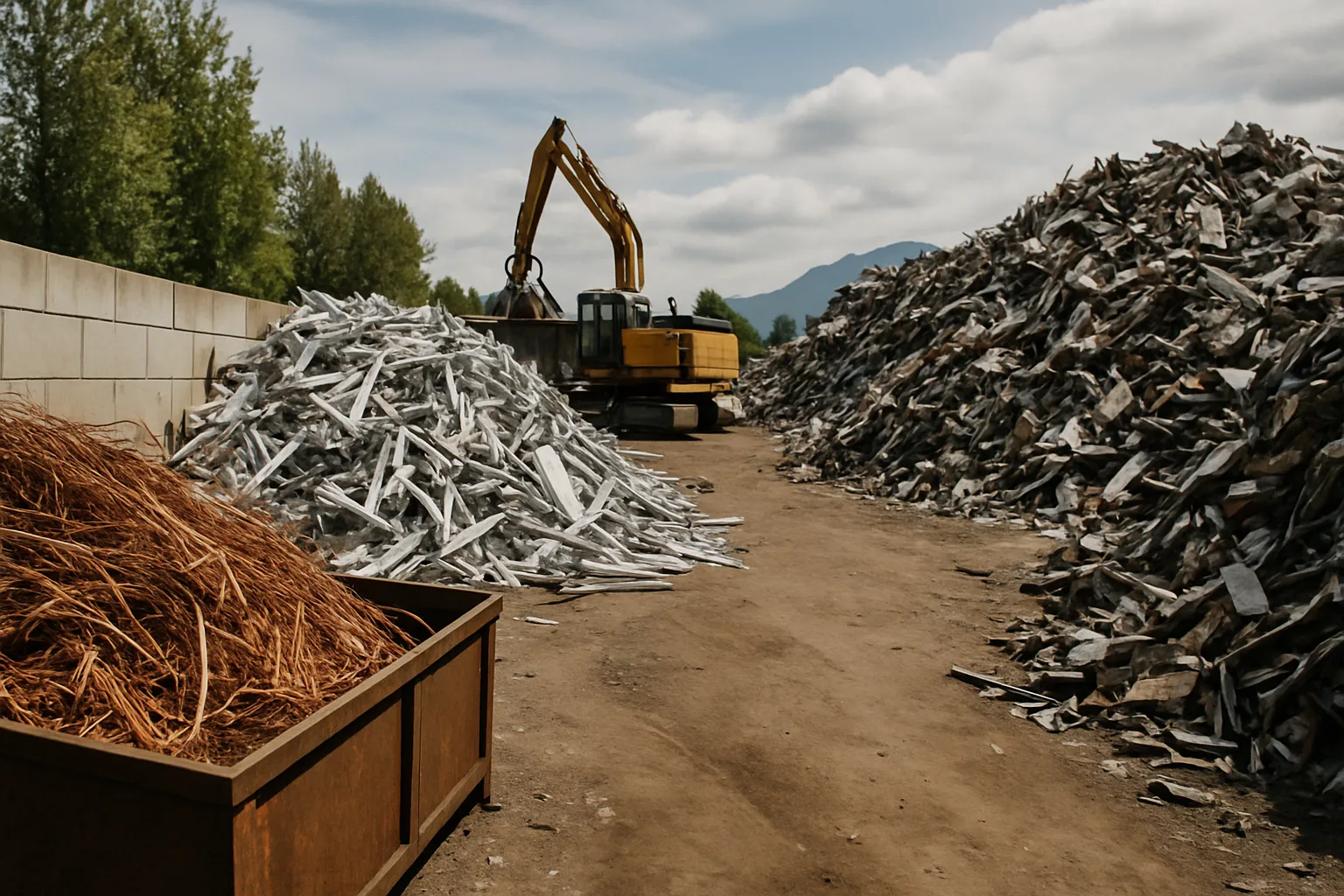
Why the Price You Get at the Yard This Week Has Nothing to Do with Your Yard
You pulled a load of copper off a demo job. The yard down the road gave you a number that felt low. You called around. Same story everywhere. What's going on? The answer isn't local — it's global. Scrap metal prices today in Canada are tied directly to commodity markets in Shanghai, manufacturing output in Germany, and tariff decisions made in Washington. Your local yard isn't setting the price. They're reading it.
Understanding that connection doesn't just satisfy curiosity. It helps you time loads, plan inventory, and stop leaving money on the table. Here's how the global economy moves through the supply chain and lands in your pocket — or doesn't.
How Global Commodity Markets Set the Baseline for Canadian Scrap Prices
Every scrap metal has a benchmark. Copper tracks the London Metal Exchange (LME). Aluminum follows LME aluminum futures. Steel scrap leans on Turkish import prices and the Midwest Hot-Rolled Coil index. These aren't suggestions — they're the numbers mills and smelters use when they make buying decisions. When LME copper moves, Canadian scrap copper prices follow within days, sometimes hours.
The chain works like this: a mill in Ontario or a smelter in British Columbia needs to buy scrap to feed production. They set their buying price based on what they can sell refined metal for. That finished metal price is tied to global demand. If Chinese manufacturing slows down — fewer cars, fewer appliances, fewer electronics rolling off the line — demand for refined copper drops. The LME price softens. The mill lowers its scrap buy. Your yard adjusts its posted rate. You feel it at the scale.
A few of the key global signals that move Canadian scrap metal prices:
- LME copper and aluminum spot prices — the most direct upstream influence on non-ferrous scrap rates
- Chinese PMI (Purchasing Managers' Index) — a leading indicator of industrial demand from the world's largest metals consumer
- U.S. manufacturing data — Canada's largest trading partner directly affects regional scrap flows
- Shipping and freight costs — when container rates spike, it costs more to move scrap offshore, which compresses margins for exporters and tightens domestic supply chains
- Currency exchange rates — a weaker Canadian dollar can make Canadian scrap more attractive to foreign buyers, which can push prices up domestically
None of this is abstract. When you're trying to decide whether to hold a load of insulated copper wire or move it now, these are the variables that matter. Check today's Canadian scrap metal prices before you make that call.
Tariffs, Trade Policy, and What 2026 Is Doing to Scrap Metal Prices in Canada
Trade policy has been one of the most disruptive forces on scrap metal markets over the past several years, and 2026 is no exception. Steel and aluminum tariffs between the U.S. and major trading partners continue to reshape how scrap flows across borders. When the U.S. restricts imports of foreign steel, domestic mills increase production — which means higher demand for domestic scrap. Canadian scrap processors close to the border can benefit from that pull. But it cuts both ways.
Retaliatory measures from trading partners can reduce demand for Canadian exports, compressing prices on the other end. Scrap that might have moved to overseas buyers at a premium suddenly needs a domestic or regional home. More supply chasing fewer buyers softens the price. Yards absorb that pressure — and so do sellers.
In British Columbia, this plays out with particular intensity because of the province's position as a Pacific gateway. Scrap exports that move through Vancouver and other B.C. ports are sensitive to Asian demand shifts, shipping costs, and any policy changes that affect offshore buyers. Yards in Chilliwack, the Fraser Valley, and across the province aren't insulated from these pressures. They're sitting right in the middle of them.
For sellers, the practical implication is this: a load of prepared aluminum or a pallet of copper that gets a good number in one month might see a materially different rate the next, with no change in quality or condition. The metal didn't change. The trade environment did. Read the latest Canadian scrap metal market updates to stay ahead of these shifts.
Local Conditions in Chilliwack and the Fraser Valley That Shape What You Actually Get Paid
Global signals set the ceiling and floor. Local conditions determine where you land in that range. Chilliwack and the broader Fraser Valley sit in a position that's both an advantage and a constraint. You're close enough to Metro Vancouver to access competitive buyers, but far enough that transportation costs eat into net returns if you're shipping small loads long distances.
Local supply and demand dynamics matter too. When a major demolition project, a mill closure, or a large industrial cleanout hits the regional market, it temporarily floods supply. Yards adjust. If your load is competing with ten other sellers bringing in the same material that week, you're not getting top of range. Timing matters — and so does documentation. A well-documented load with photos, weights, and clear material grades gives buyers confidence to bid competitively. A mystery pallet gets a mystery price.
The aluminum recycle value in the Fraser Valley, for example, tracks closely with LME aluminum but also reflects what local buyers are currently paying for specific grades. Painted aluminum siding, cast engine components, extrusions, and sheet aluminum all carry different values. Knowing the difference — and presenting your material clearly — isn't just housekeeping. It's money. Platforms like smashrecycling.ca help sellers present documented inventory to vetted buyers, which supports better price discovery regardless of what the global market is doing on any given day.
Catalytic Converters: The Most Globally Sensitive Scrap Item You're Likely Holding
If you deal in cats, you already know the price swings are brutal. Catalytic converters contain platinum group metals (PGMs) — platinum, palladium, and rhodium — and these are among the most globally traded and speculative commodities in the metals market. Palladium alone has swung by hundreds of dollars per troy ounce within a single quarter in recent years. That swing moves directly to the per-unit value of the cats in your bin.
PGM prices are driven by a narrow band of global factors: South African and Russian mining output (which together dominate global platinum and palladium supply), automotive production volumes (the primary use case for PGMs), and the ongoing transition toward electric vehicles, which reduces long-term demand for traditional catalytic converters. In 2026, the EV transition continues to reshape this market in real time. The result is a catalytic converter auction environment where price transparency and competitive bidding matter more than ever.
Selling cats to a single buyer without knowing the current assay values is the equivalent of selling copper without checking LME. You might be leaving significant money behind. SMASH runs a competitive auction format for cats and other high-value scrap items, putting your inventory in front of vetted buyers and letting market competition do what it's supposed to do: reveal the price. That's not a sales pitch — it's just how price discovery works when you have real competition.
What Sellers Can Do Right Now to Work Smarter in a Volatile Market
You can't control the LME. You can't move the PMI. What you can control is how you sell. A few practical approaches that make a real difference in a volatile market:
- Track the upstream indicators. LME copper and aluminum prices are publicly available. A five-minute check before you price a load tells you whether the market is running or pulling back.
- Document everything. Photos, weights, grades, and VINs (for vehicles) or serial numbers (for certain industrial equipment) increase buyer confidence and support stronger bids. This isn't extra work — it's leverage.
- Get multiple buyers in the room. One buyer gives you one price. Competition gives you a market price. SMASH puts vetted buyers in an auction format so the market — not one buyer's margin target — sets the number.
- Time loads when you can. Not always possible, but if you're holding non-ferrous and the LME is trending up, patience has a dollar value. If it's trending down, moving sooner protects you.
- Know your grades. Mixing high-value and low-value material into one lot is a fast way to get paid for the lowest common denominator. Segregate where it makes sense.
For sellers in Chilliwack and across British Columbia trying to sell scrap metal near me for cash, working smarter starts with having better tools and better information. Find current Canadian scrap metal prices and use that data as your baseline before you pick up the phone.
Staying Ahead: The Market Moves Fast, but So Can You
Global economics are complex. But the takeaway for a yard operator or independent scrap collector isn't. Watch the upstream signals. Document your loads. Sell into competition, not into a single buyer's open hand. Use platforms like SMASH that align their success with yours — no subscription fees, no guessing.
Scrap metal prices today in Canada are a real-time reflection of global manufacturing health, trade policy, currency movements, and commodity speculation. The sellers who treat that as useful information — rather than background noise — consistently come out ahead. Chilliwack and the Fraser Valley have active buyers and real demand. The question is whether you're capturing your share of it.
Stay current. Check today's Canadian scrap metal prices and get current rates at scrap-metal-prices.ca — it's the fastest way to know whether today is the day to move your load.
Prices fluctuate daily based on global market conditions. Always verify current rates directly with buyers or through current market sources before making selling decisions.
Frequently Asked Questions
Q: Why do scrap metal prices change so often in Canada?
Canadian scrap metal prices are tied to global commodity exchanges like the London Metal Exchange, which update continuously based on supply, demand, manufacturing output, and trade policy. A shift in Chinese industrial activity or a change in U.S. tariff policy can move prices within days. Local supply conditions — how much material is flowing into regional yards — also affect what buyers are willing to pay week to week.
Q: How do I know if I'm getting a fair price for scrap in Chilliwack?
The best way is to check current LME benchmarks and compare against posted rates at multiple buyers. Platforms like SMASH create competitive auctions that put your material in front of vetted buyers, which helps reveal the actual market price rather than a single buyer's offer. Documented, well-graded loads consistently attract stronger bids than unsorted material.
Q: What scrap metal has the most value right now in British Columbia?
Non-ferrous metals — copper, aluminum, and platinum group metals from catalytic converters — consistently carry the highest per-pound values. Copper grades like bare bright and #1 copper wire typically lead the pack. PGM values in cats fluctuate significantly based on global palladium and platinum markets. Steel and iron are higher volume but lower per-pound value. Check current rates at scrap-metal-prices.ca for today's numbers.
Q: Does the Canadian dollar exchange rate affect scrap metal prices?
Yes, directly. Scrap metal is priced globally in USD, so when the CAD weakens against the USD, Canadian scrap becomes relatively cheaper for foreign buyers — which can increase export demand and support domestic prices. Conversely, a stronger CAD can soften the export appeal of Canadian scrap. Currency movements are one more reason scrap metal prices today can shift without any change in local supply conditions.
Q: Is it worth holding onto catalytic converters or should I sell them now?
That depends on current PGM spot prices and your read on the market direction — neither of which anyone can predict with certainty. What's certain is that selling cats to a single buyer without competitive bids often leaves money behind. A catalytic converter auction format through a platform like SMASH gives you verified buyers competing on your material, which is a better starting point than a single over-the-counter offer.
Follow SMASH on LinkedIn for ongoing scrap metal market insights, price trend updates, and industry news across North America.