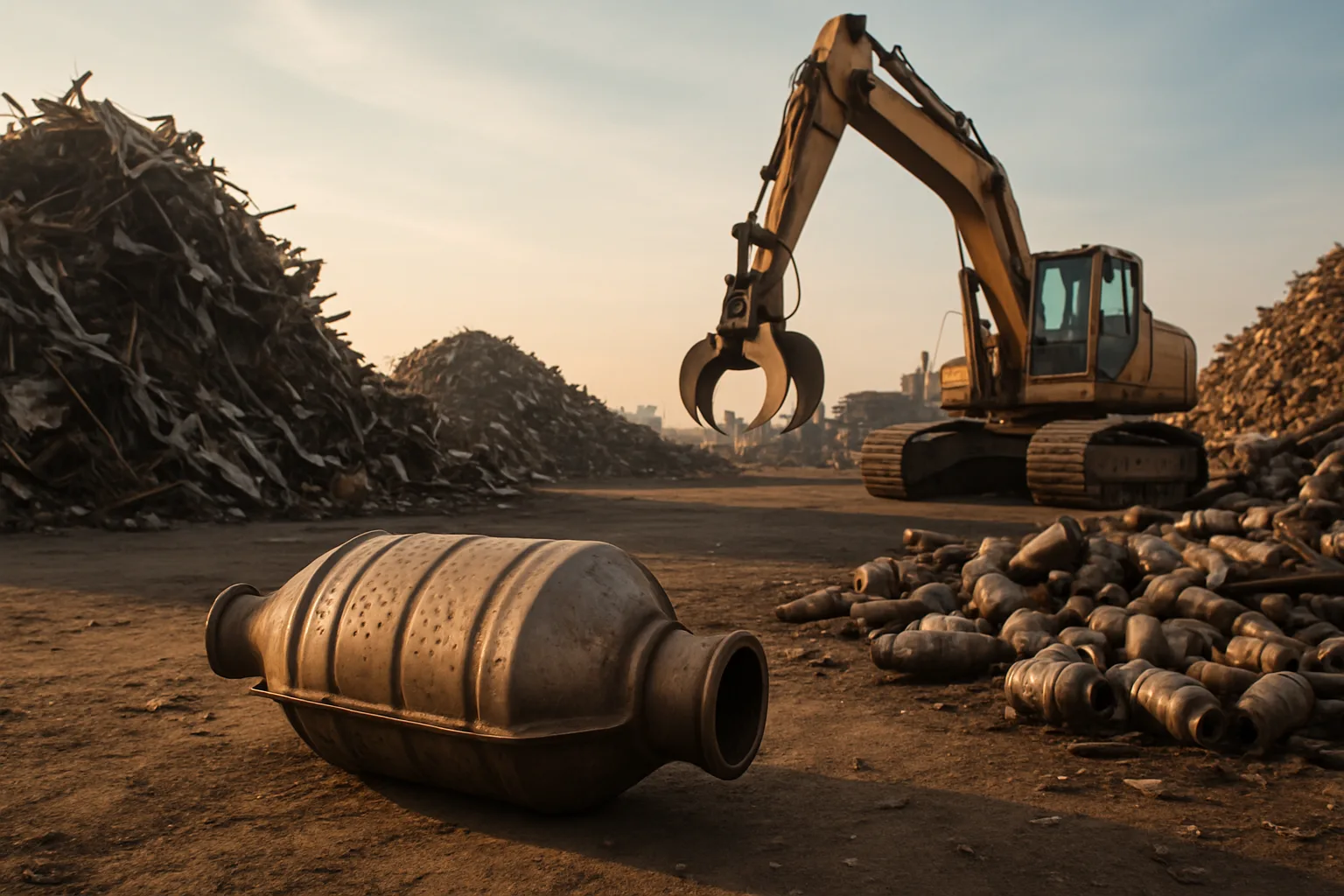
Most sellers know catalytic converters are worth something. Few understand why the gap between the best price and the worst price can be hundreds of dollars on a single unit.
That gap isn't random. It comes down to metal content, market timing, and whether the buyer actually knows what's in the converter they're purchasing. If you're hauling cats to a yard in Brampton or anywhere else in Ontario, understanding how pricing works puts money back in your pocket.
This article breaks down exactly how catalytic converter recycling works, what drives price variation, and how platforms like SMASH help you find the best price for your scrap in Canada instead of guessing at the counter.
What's Actually Inside a Catalytic Converter
The value isn't in the steel shell. It's in the substrate inside — a ceramic or metallic honeycomb coated with platinum group metals (PGMs): platinum, palladium, and rhodium. These are rare. They're critical to the converter's job of reducing toxic exhaust emissions. And they're what recyclers are actually buying when they quote you a price.
The problem is you can't see PGM content from the outside. Two converters that look nearly identical can have wildly different PGM loadings depending on the vehicle make, model, engine size, and model year. A direct-fit cat off a late-model hybrid carries far more palladium than a generic aftermarket unit off an older economy sedan. One might fetch $400. The other might be worth $30.
- Platinum — historically the dominant PGM in diesel converters
- Palladium — dominates in gasoline converters; prices have stayed elevated for years
- Rhodium — present in smaller quantities but extremely valuable per gram
The ratio of these three metals, combined with how much substrate remains intact, determines the actual payout. No substrate, no PGMs. A converter that's been cracked, baked out, or previously processed is essentially a steel shell worth a few dollars for its scrap value alone.
How Catalytic Converter Recycling Actually Works — From Your Yard to Refinery
Most sellers think the yard buying their cats is the end of the chain. It isn't. There are typically three to four steps between a converter leaving your hands and the PGMs being recovered.
- Collection and sorting at the yard. The buyer groups converters by type — OEM or aftermarket, diesel or gasoline, substrate-intact or damaged. Visual identification and serial number lookup happen here. Tools like VIN lookup and serial tracking help experienced buyers grade units faster and more accurately.
- Consolidation into loads. Individual yards accumulate converters into larger lots — often hundreds or thousands of units — before shipping to a processor. The larger the lot, the more negotiating leverage the seller has.
- Assay at the processor. The processor decans the converter (removes the ceramic substrate from the steel housing), mills the substrate into a fine powder, and runs assay testing to measure exact PGM content. This is where the real number comes from.
- Refining and settlement. PGMs are chemically separated and refined to commercial purity. Settlement back to the seller is based on the assay result, minus processing fees.
The further down the chain you sell, the closer you get to the actual assay price. Most small sellers don't have the volume to access processor-level pricing directly. That's where competitive auctions for full loads become relevant — more on that below.
Why Copper Scrap Prices Brampton Sellers See Don't Tell the Whole Cat Story
Copper scrap prices in Brampton and broader scrap metal prices across Ontario follow commodity markets closely. LME copper, aluminum, and steel benchmarks move daily. Catalytic converter pricing operates on the same logic but references PGM spot prices instead — and PGM markets are significantly more volatile.
Rhodium, for example, has historically swung from under $1,000 USD per troy ounce to over $20,000 within a multi-year window. Palladium has moved sharply with automotive production forecasts and the shift toward battery electric vehicles (BEVs). Platinum has faced persistent pressure as diesel vehicle sales decline in key markets. In mid-2026, those dynamics continue to play out in real time.
This volatility explains a big part of why the price you're quoted today differs from what you heard last month. It also explains why the yard quoting you a flat rate per unit — without referencing current PGM spot prices — may not be giving you the best number available. When you check today's Canadian scrap metal prices, you get a clearer baseline for what the market is doing. That context makes you a harder person to lowball.
Beyond PGM spot prices, local factors in Brampton and the Greater Toronto Area also influence what individual yards will offer:
- Current demand from processors in Ontario and across the border
- The yard's existing inventory of cats (a yard sitting on a large unsold lot may offer less)
- Whether you're selling one unit or a full pallet
- How well the unit has been identified and documented
Scrap Metal Inventory Management and Why Documentation Changes Your Price
One of the most consistent ways sellers leave money on the table is showing up without documentation. A converter with a legible serial number, a known vehicle source, and clear photo documentation is a different product than an anonymous unit in a pile. Buyers discount uncertainty. If they can't identify the unit, they price it conservatively to protect their margin.
Good scrap metal inventory management applies directly to catalytic converters. Tracking units by serial number, recording the source vehicle's VIN, photographing both ends of the converter, and noting visible condition — these steps take minutes but can meaningfully shift what a buyer is willing to pay. A buyer looking at a well-documented lot of 50 cats has more confidence than a buyer looking at 50 mystery units in a bin.
Platforms that support serial tracking, photo documentation, and VIN lookup aren't just administrative tools. They're price tools. The more a buyer knows, the more they'll bid. That's not theory — it's basic price discovery logic. Documented inventory gives buyers more confidence, and confident buyers bid higher.
If you operate a yard in Brampton or anywhere else in Ontario and you're processing converters regularly, building an inventory workflow is one of the highest-ROI operational changes you can make. It doesn't require expensive software — it requires discipline and the right platform to bring buyers to your documented lots.
How Competitive Auctions Change the Pricing Math for Catalytic Converters
The traditional model for selling cats is straightforward: call your buyer, get a price, take it or leave it. Most sellers take it, because finding another buyer takes time and effort they don't have.
That single-buyer dynamic is exactly where sellers lose money. Not because the buyer is acting in bad faith — because the buyer has no incentive to offer more than necessary. Without competition, price discovery doesn't happen. You're not finding the market; you're accepting an offer from one point in the market.
SMASH changes that structure. Instead of one phone call to one buyer, your documented lot of cats goes in front of multiple vetted buyers at once. They bid. You see competition happen in real time. That competition can help reveal the market — and more buyers means better price discovery.
There are no subscription fees. SMASH only wins when you win. For yards moving regular volume of converters — whether you're near the scrap yard Toronto corridor or operating further west in Brampton — that structure is worth understanding.
To read the latest Canadian scrap metal market updates and stay current on PGM trends, bookmark resources that track commodity pricing alongside local scrap rates.
What Sellers in Brampton Should Know Before Their Next Cat Sale
Selling catalytic converters isn't complicated, but selling them well requires a few habits that most sellers skip. Here's what consistently separates sellers who get strong prices from those who don't.
- Know what you have before you sell. Use a serial number lookup to identify your units. OEM converters from known vehicles have documented PGM content. Don't sell an unknown unit as an unknown unit if 30 seconds of research can identify it.
- Document before you move the load. Photograph both ends of each converter. Record serial numbers. Note the source vehicle if you have it. This takes less time than arguing about price at the counter.
- Check current PGM spot prices. You don't need a Bloomberg terminal. Palladium, platinum, and rhodium spot prices are publicly available. Know where they are before you accept a per-unit quote.
- Sell in volume when you can. Single units rarely get you processor-adjacent pricing. Accumulate a meaningful lot and bring buyers to compete for it.
- Use competitive channels. One buyer, one price is the old way. Auction-based platforms that bring multiple vetted buyers to your lot give you actual price discovery instead of a take-it-or-leave-it number.
The scrap metal market in Ontario moves fast. Whether you're tracking scrap metal prices Brampton yards post daily or watching PGM markets shift week over week, staying informed is part of the job. You can always find current Canadian scrap metal prices to keep your baseline sharp.
Catalytic converter pricing isn't a mystery — it's a function of metal content, documentation quality, market timing, and who's bidding. Fix the variables you control, and let SMASH handle the competition side. That's how you stop guessing and start selling.
Frequently Asked Questions
Q: Why do catalytic converter prices vary so much between scrap yards in Brampton?
Different yards have different buyer relationships, different lot sizes, and different ability to identify specific converter types. A yard with strong processor connections and good identification tools can offer more than one quoting generically. Documentation and competitive bidding close that gap significantly.
Q: How do I know if I'm getting a fair price for my cats at a Brampton scrap yard?
Check current PGM spot prices (platinum, palladium, rhodium) before you sell. Know what type of converter you have — OEM or aftermarket, and from what vehicle. If your buyer can't explain how they're pricing your specific unit, that's a red flag worth paying attention to.
Q: Does the condition of a catalytic converter affect its scrap value?
Yes — significantly. A converter with an intact ceramic substrate retains its PGM content. Units that have been cracked, overheated, or previously decanned may have little to no recoverable PGM value regardless of exterior appearance. Always check the substrate before assuming full value.
Q: Are copper scrap prices in Brampton related to catalytic converter prices?
They're both scrap metal commodities, but they reference different markets. Copper scrap prices track LME copper. Catalytic converter prices track PGM spot prices — platinum, palladium, and rhodium — which are separate and often more volatile. Monitoring both gives you a fuller picture of the scrap market in Ontario.
Q: How does SMASH help with catalytic converter sales?
SMASH brings vetted buyers to your documented loads through a competitive auction format. Instead of calling one buyer for one price, your lot gets bid on by multiple buyers simultaneously. That competition drives better price discovery. There are no subscription fees — SMASH earns only when you complete a sale.
Prices in the catalytic converter market shift with every PGM spot price move. The best time to understand your inventory's value is before you walk into a yard. Check today's Canadian scrap metal prices and stay current on the market at scrap-metal-prices.ca — and when you're ready to sell, bring competition to your load.
Disclaimer: Scrap metal and PGM prices fluctuate daily based on commodity markets and local demand. Always verify current rates before completing a transaction.
Follow SMASH on LinkedIn for ongoing scrap metal market updates, PGM pricing insights, and industry news relevant to Canadian yard operators and sellers.